
| View |
| preceded by | |
 Katanga (1960 - 1963)
|
| succeeded by |
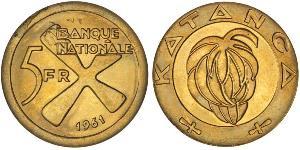
| Katanga (1960 - 1963) | Link to Wikipedia |
State of Katanga: History, Coinage and Collectibles
Welcome to an exclusive exhibition dedicated to one of history’s most volatile economic experiments: the State of Katanga (Inchi Ya Katanga). As a curator specializing in African numismatics, I have curated this retrospective not merely on metal content or mint errors, but on how currency shaped—and was shaped by—a desperate bid for sovereignty. Between 1960 and its dissolution in 1963, the breakaway state stood as an island of copper wealth against a backdrop of political chaos.
Historical Background
The narrative begins with mineral riches that were too significant to ignore. By the mid-20th century, Katanga was not just a province; it was a fortress economy built upon deposits of uranium, tin, and immense copper reserves. In 1960, as the Belgian Congo moved toward independence under Prime Minister Patrice Lumumba, tension in this mineral-rich region reached an breaking point.
The central drama played out between two factions: those loyal to Léopoldville (Kinshasa) and the secessionists led by Moïse Tshombe. The wealth drawn from mining attracted approximately 32,000 Belgian settlers who felt displaced as political power shifted to a non-white majority government. These white residents viewed an exit through independence as existential.
The turning point came on July 11, 1960. Condemning the central government for what they termed communist influence and dictatorial overreach, Tshombe declared secession with immediate backing from Union Minière du Haut Katanga (UMHK). The mining company provided a staggering financial advance of $25 million to fund the rebellion—an amount that underscored how much economic power was concentrated in the hands of private interests. This funding allowed the state to build its own military gendarmerie and maintain order, creating an economy that functioned almost like a corporate fiefdom.
Currency and Coinage History
A common misconception among general historians is that secession implies immediate currency independence. In Katanga’s case, the situation was nuanced. For much of its brief existence, the state used existing colonial currency systems before establishing any distinct monetary policy due to time constraints.
- The Initial Currency Struggle: Upon declaring independence in July 1960, the State did not immediately create a new banknote series. Instead, it utilized local banks and UMHK scrip that were often backed by gold or foreign currency reserves to ensure solvency.
- The CFA Franc Transition: The region was tied to the wider Central African Federation economy (later reorganized into France's financial zone). While Katanga sought political autonomy, their economic reality forced them to navigate complex monetary unions. This meant that "Katangese" notes often bore distinct overprints or slogans supporting Tshombe’s administration.
- The Role of the Belgian Connection: The state was heavily assisted by a mission called Mistebel (Mission Technique Belge). Consequently, early currency used in Élisabethville retained visual similarities to French Colonies or CFA Francs until political directives from Brussels were suspended. This overlap creates fascinating numismatic puzzles for collectors trying to date notes based on subtle design shifts.
The state dissolved following Operation Grandslam by late 1963, ending its unique monetary experiment and reintegrating the province into a unified Congo later renamed Zaire (now DRC). However, this brief window of economic separation remains one of the rarest chapters in African coin history.
Mints and Coin Production
To understand why "State of Katanga" coins are so elusive to collectors, we must examine their minting infrastructure. Unlike major powers with permanent mints for silver or gold bullion, this entity lacked a sovereign mint house within its borders.
External Mint Reliance
The production and distribution of money were handled by Belgian entities. The Caisse Centrale de la Confédération des Associations Tribales du Katanga (CONAKAT), often linked to the mining company UMHK, utilized printing presses likely supplied through Brussels or Paris.
Mint Technology in a Crisis
The technology used during this crisis period was standard 1960s offset and engraving. However, scarcity drove their use of high-quality security features on notes to maintain confidence against inflation from government spending. Collectors prize these artifacts because they are rare finds—often representing the only known instances where a specific entity issued its own political currency during active conflict.
In numismatic terms, "Mint Production" for this state is best understood through banknotes and token circulation rather than traditional mint-milled coins of gold or silver. The focus was on practicality: funding salaries, paying the gendarmerie raised by Belgian officers (like Colonel Muke), and importing equipment.
Notable Coins
(Note to Collectors: In this unique case study of numismatics, "Coins" often refers to banknotes or rare commemorative tokens rather than standard coinage. The following highlights are historically significant for historians and collectors alike).
The Secession Banknote Series
Historical Context: These notes were produced in late 1960 just as the secession was declared.
Design Features: They typically featured imagery related to mining—copper ingots, pickaxes, and industrial landscapes—which reinforced the political argument that Katanga’s wealth belonged entirely to its own people. The portraits often depicted Tshombe or local CONAKAT leaders rather than colonial figures.
Collector Importance: These are the "holy grail" for secession collectors. They serve as physical proof of the state's sovereignty at a specific moment in time, bearing no resemblance to standard CFA notes issued later by Zaire or France.
Copper-Themed Tokens
Historical Context: With coins being scarce during this period due to lack of mint capacity, small tokens were produced for local transactions within mining towns like Élisabethville (now Lubumbashi).
Design Features: These bore the Union Minière logo or Tshombe’s name in both French and Swahili. They often featured copper-colored plating to visually represent the region's primary commodity.
The Military Gendarmerie Token
Historical Context: The Katangese military force, heavily trained by Belgium and led by Colonel Norbert Muke, needed internal payment methods when official banking was halted during ONUC blockades.
Design Features: These were high-security paper tokens or metal scrip used within the garrison.
Cultural Legacy
The legacy of Katangan currency extends far beyond its material value; it symbolizes a clash between economic pragmatism and political ambition. The coins, notes, and tokens from this era capture the spirit of Cold War conflict in Africa—where mineral wealth was pitted against democratic centralization.
Culturally, the designs reflected a blend of Belgian colonial aesthetic traditions (neoclassical portraiture) and indigenous African symbolism used by Tshombe's government to assert legitimacy. This fusion creates an artistic style that is distinct from standard French or Congolese issues found in museum archives.
For Collectors: The Hunt for History
Why does the State of Katanga matter? It represents one of history's most dramatic attempts at economic self-determination. For collectors, it offers a chance to own pieces that document a short-lived political experiment fueled by $25 million in mining wealth.
- Rarity: The primary value here is historical scarcity. Since the state collapsed within three years and was forcibly reintegrated into Zaire's monetary system, there are no large-scale mint productions found like those of a stable empire.
- Historical Provenance: A piece marked with specific dates from July 1960 to January 1963 is more valuable than later standard currency because it links directly to the events surrounding Lumumba’s assassination and the UN intervention.
In summary, while you may not find a large cache of silver or gold coins on your shelf today, hunting for these specific paper notes or rare tokens allows collectors to hold physical proof of one of Africa's most contentious periods. It is an investment in history itself—preserving the story of Moïse Tshombe’s vision and the miners who sought wealth through their own sovereign hands.