| View |
| preceded by | |
| Cappadocia |
| succeeded by |
| Cappadocia | Link to Wikipedia |
Cappadocia: History, Coinage and Collectibles
Historical Background
In the vast tapestry of ancient Anatolia, Cappadocia stands as a testament to the enduring fusion of civilizations. This region once known in antiquity as Hatti served as the cradle for one of history's first great empires, centered at their capital city of Hattusa during the late Bronze Age. As time marched on and the political winds shifted with the fall of this ancient power, Cappadocia emerged under Persian administration. It became a vital satrapy within the Achaemenid Empire, bridging the gap between Mesopotamia and Greece while maintaining its unique cultural autonomy.
The historical trajectory of the region took a transformative turn following Alexander the Great's conquests in the fourth century BC. While many territories were fragmented or annexed directly into Greek rule, Cappadocia retained an aristocratic governance structure under Ariarathes I who declared independence and assumed royal titles shortly after his patron Perdiccas died.
This period marked a unique moment where local tradition met Hellenistic influence without the immediate interference of direct central administration. The region flourished as a kingdom that navigated the complex politics between Rome, Persia, and the successor states of Alexander's empire for nearly two centuries. During this era, trade routes traversed through Cappadocian territory connecting the Black Sea ports with Mesopotamia. This economic positioning meant that the local economy was robust enough to require its own coinage systems to facilitate commerce across diverse cultures.
Cultural life in ancient Cappadocia remained a distinct blend of Luwian heritage, Armenian influences from the north-east, and Greek traditions brought by settlers and trade. The landscape itself fostered settlement patterns unique for their rock-cut architecture, but economically, it relied on its central location within Asia Minor to act as an inland transit point rather than relying solely on Mediterranean sea trade.
Currency and Coinage History
The story of money in Cappadocia is one of evolution from imperial coinage to local autonomy. In the earliest stages, under Persian suzerainty, the region utilized large silver darics that were struck elsewhere but circulated widely. These heavy coins represented wealth stored for tribute purposes rather than everyday transaction currency.
Following Alexander's campaigns and his death in 323 BC, Cappadocia became an independent kingdom again under Ariarathes I around 300 BC. The transition from using Persian or imperial Greek drachms to minting local coinage occurred slowly but determinedly throughout the third century BC.
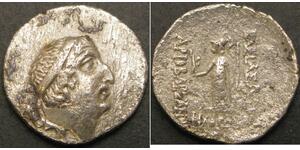
The introduction of silver tetradrachms marked a significant economic shift, aligning Cappadocia with Hellenistic standards while retaining distinct stylistic variations in their legends. By the second century BC, coins were struck not only for tribute or taxation, but as functional currency used by merchants throughout Anatolia and beyond.
The economy relied heavily on silver coinage because gold sources had become scarce in later periods of this era. The minting practice evolved to reflect political stability; when local dynasts secured their power against external threats from the east, they issued coins bearing Greek legends asserting their sovereignty. This numismatic independence continued until Roman annexation occurred after a war during Emperor Augustus's reign around 17 AD.
Mints and Coin Production
The primary production centers for Cappadocian coinage were situated near the ancient capital known as Mazaca, which was renamed Caesarea. While archaeological evidence of exact mintage workshops is limited due to site destruction over millennia, historical records suggest that royal patronage controlled these facilities tightly.
Mint operations in this region adhered to the Hellenistic tradition where a die cutter would strike obverse and reverse faces onto blanks struck by hand-hammer or mechanical presses. Early pieces show evidence of high-quality craftsmanship typical of Seleucid workshops before Cappadocian artisans developed their own aesthetic language.
The artistic characteristics that distinguish these coins include distinctive horse depictions, which reflected the local aristocracy's association with cavalry warfare and equestrian traditions mentioned by Herodotus. The reverse designs often featured mythological figures like Zeus or Hera alongside specific symbols such as lyres or shields bearing Greek letters.
Metal quality varied throughout history to reflect political pressure; sometimes coins were made of silver that was alloyed with other metals for weight control, which is a common practice among states trying to maintain solvency during turbulent times. Despite economic fluctuations due to wars and border pressures from neighboring Galatia or Syria, the mint output remained consistent enough to support local markets.
Notable Coins
- The Ariarathes I Tetradrachms:
- This early series is a cornerstone for collectors. These large silver coins feature the head of Heracles or Apollo on one side and Zeus holding lightning bolts on the reverse, emphasizing royal connection to divine patronage.
- The Pegasus Drachms:
- Minted during later dynastic reigns. These are highly recognized for their artistic refinement featuring winged horse depictions that celebrate local legends about the Taurus mountain range nearby which inspired many regional stories.
- Roman Period Issues:
- Minted after 17 AD, these coins bear imperial portraits rather than Cappadocian rulers. They are rare and historically important as they document the end of independence before shifting into provincial status within the Roman Empire.
Each coin type serves not just as a medium for exchange but as an artifact telling stories about dynastic legitimacy, military power through cavalry imagery, and religious devotion that mirrored local practices found in later Byzantine times. Collectors often prize these types because they bridge the gap between Persian history arriving with Alexander's empire.
Cultural Legacy
The coinage of Cappadocia serves as a mirror to its broader cultural identity, blending Iranian traditions from earlier satraps into Greek artistic styles that eventually gave way to Roman imperial standards. Every relief sculpted onto these silver blanks reflected the high culture and literacy present in regions like Asia Minor.
Religious symbols found on coins often paralleled the architectural wealth seen elsewhere within Cappadocia today, where underground cities were carved into volcanic rock during periods of persecution. While modern visitors see fairy chimneys that shaped landscapes millions of years ago through erosion from ancient volcanoes, these same geologic processes helped stabilize settlements built in strategic fortresses referenced on some coin reverse legends.
The economic integration shown by coins indicates Cappadocia's pivotal role as a hub where ideas and technologies could travel freely between the Mediterranean ports of Syria and the inland Anatolian heartlands. This connectivity is preserved physically in every surviving specimen found within museum collections worldwide, representing an ancient society that valued trade over isolationism despite its central location.
For Collectors
The region remains a focal point for specialists interested in pre-Roman Anatolia and the early Hellenistic world. Because few nations minted coins under their own names during this specific window of time, surviving examples are inherently rare within global numismatic catalogs.
The value of these pieces for collectors often stems not just scarcity but also condition and die variety found within major museum archives. Each piece connects to narratives of ancient trade networks that defined the region as much as its volcanic geology does today, offering a tangible link between archaeological digs and historical economic analysis.