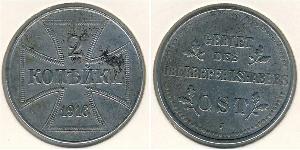
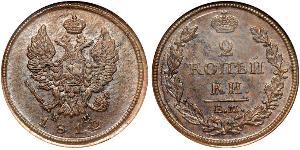
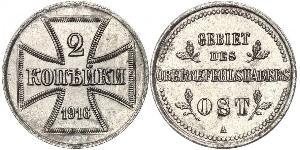
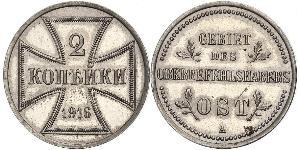
2 Kopeck Germany Steel
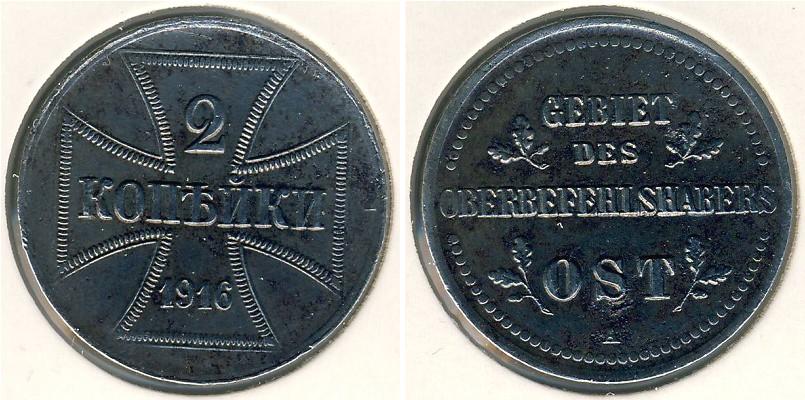
German Occupation during WWI
Ober Ost is short for Oberbefehlshaber der gesamten Deutschen Streitkräfte im Osten, German for "Supreme Commander of All German Forces in the East" during World War I. In practice it refers not only to said commander, but also to his governing military staff and the district they controlled: Ober Ost was in command of the German section of the Eastern Front.
Ober Ost, set up by Kaiser Wilhelm II. in November 1914, initially came under the command of Paul von Hindenburg, a Prussian general who had come out of retirement to achieve the German victory of the Battle of Tannenberg in August 1914 and became a national hero. When the Chief of the General Staff Erich von Falkenhayn was dismissed from office by the Kaiser in August 1916, Hindenburg took over at the General Staff, and Prince Leopold of Bavaria took control of the Ober Ost.
By October 1915 the Imperial German Army had advanced so far to the east that Central Poland could be put under a civil administration – accordingly, the German Empire established the Government General of Warsaw and the Austro-Hungarian Empire set up the Government General of Lublin. The military Ober Ost government from then on controlled only the conquered areas east and north of Central Poland.
After the signing of the Treaty of Brest-Litovsk of March 1918, the German Empire effectively controlled Lithuania, Latvia, Belarus, parts of Poland, and Courland, all of which had formerly formed part of the Russian Empire. Ober Ost itself controlled present-day Lithuania, Latvia, Belarus, Poland, and Courland. The land area it administered was around 108,808 km2 (42,011 sq mi).
Ober Ost ruled the land with an iron fist. The movement policy or Verkehrspolitik, divided the land without regard to the existing social and ethnic organization and patterns. One was not allowed to move between the districts, which destroyed the livelihood of many merchants and prevented indigenous people from visiting friends and relatives in neighboring districts. They also tried to “civilize” the people in the Ober Ost-controlled land, attempting to integrate German ideals and institutions with existing cultures. They constructed railroads but only Germans were allowed to ride them and schools were taught by German instructors, since they lacked trained Lithuanians.
In 1915, when large territories came under Ober Ost’s administration as a result of military successes on the Eastern Front. Erich Ludendorff, von Hindenburg’s second in command, set up a system of managing the large area now under its jurisdiction. Although von Hindenburg was technically in command, it was Ludendorff who had actual control of the administration. There were ten staff members, each with a specialty (finance, agriculture, etc.). The area was divided into the Courland District, the Lithuania District and the Bialystok-Grodno District, each overseen by a district commander. Ludendorff’s plan was to make Ober Ost a colonial territory for the settlement of his troops after the war as well as provide a haven for German refugees from inner Russia. Ludendorff quickly organized Ober Ost so that it was a self-sustaining region, growing all its own food and even exporting surpluses to Berlin. The largest resource was one that Ludendorff was unable to exploit effectively: the local population had no interest in helping obtain a German victory as they had no say in their government and were subject to increasing requisitions and taxes.
| 1 | 2 |
|---|
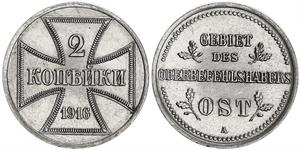
Posted by: anonymous 2018-03-13
Oberbefehlshaber Ost. 2 Kopeken 1916 A. Jaeger 602. Zaponiert, fast Stempelglanz
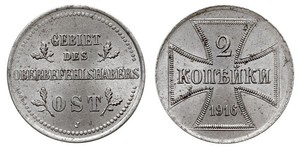
Posted by: anonymous 2016-03-17
POLAND - XX century; Poland - German occupation of Eastern Europe. 2 kopiejki (kopecks) 1916/J, Hamburg, Parchimowicz 2.b, piękne - GRADE: I ( UNC )
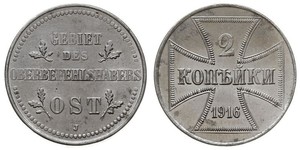
Posted by: anonymous 2016-03-17
Poland - German occupation of Eastern Europe; 2 kopiejki 1916 J, Hamburg, Parchimowicz 2.b, piękne - GRADE: I/I-
Posted by: anonymous 2015-11-17
Oberbefehlshaber Ost 2 Kopeken 1916 A. Jaeger 602. Vorzüglich - Stempelglanz
Posted by: anonymous 2015-11-19
Oberbefehlshaber Ost 2 Kopeken 1916 A. Jaeger 602. Winz. Fleck. Polierte Platte