1 Ducat Electorate of Bavaria (1623 - 1806) Gold
-eFUKbzbiGM0AAAFFoavGZvd9.jpg "1 Ducat Electorate of Bavaria (1623 - 1806) Gold")
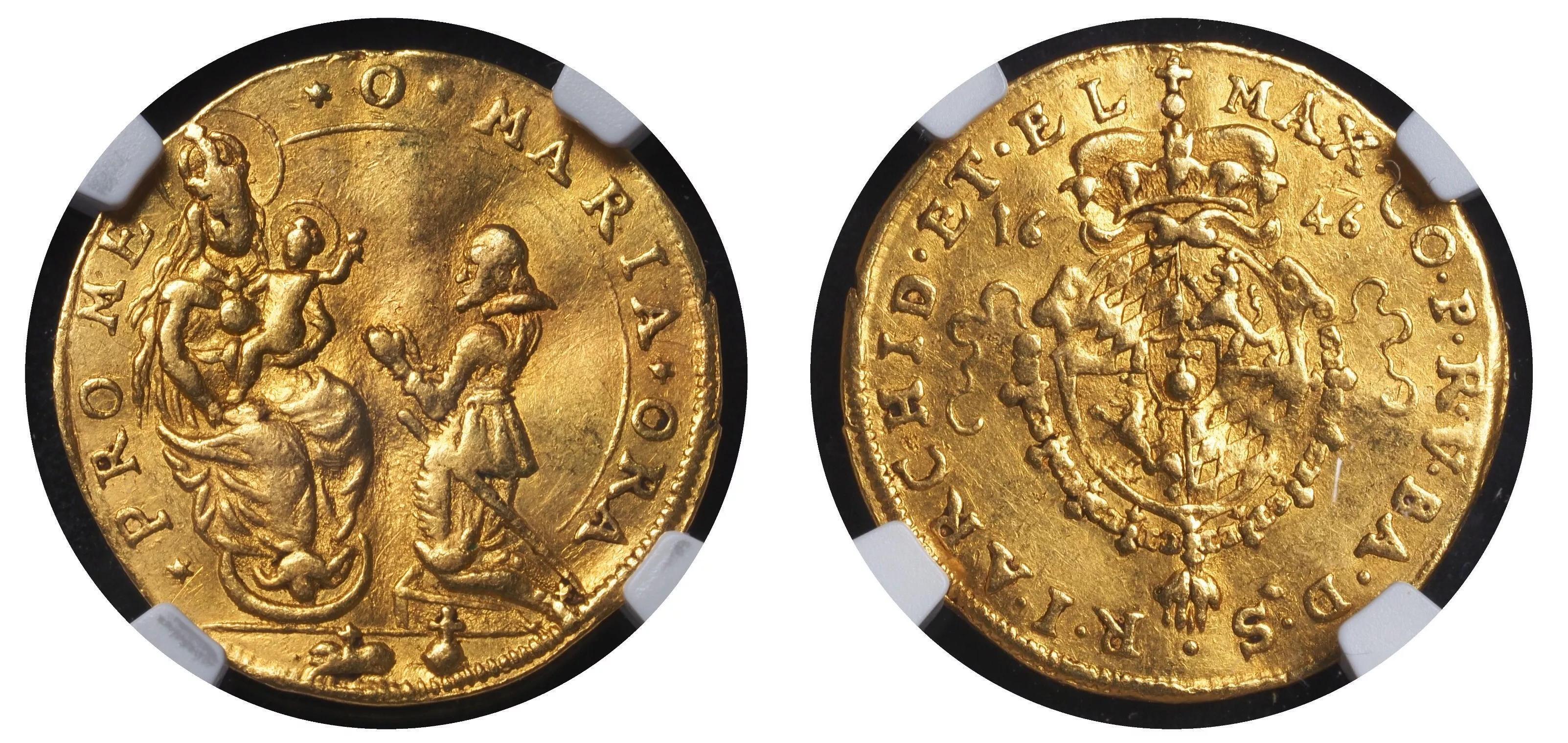
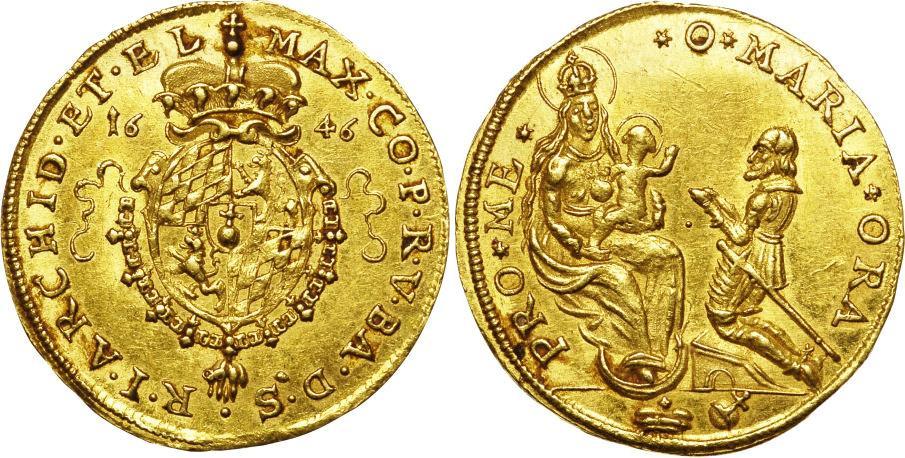
Bavaria, Maximilian I. Gold Ducat Coin.
Mint Year: 1646
Mint Place: Munich
Denomination: Gold Ducat
Reference: Friedberg 195, KM-274
Diameter: 21mm
Material: Gold!
Weight: 3.4gm
Obverse: The Duke kneeling and praying in front of the Virgin Mary (Madonna), which is holding baby-Jesus child. Ducal crown and cross-topped orb on ground below.
Legend: * PRO BE * O * MARIA * ORA
Reverse: Ducal crown on oval coat-of-arms of the Electorate of Bavaria within Toison d’Or collar. Date (16-46) split in fields above.
Legend: MAX . CO . P . R . V . BA . D . S . R . I . ARCHID . ET . EL
Maximilian I, Duke/Elector of Bavaria (17 April 1573 – 27 September 1651), called “the Great”, was a Wittelsbach ruler of Bavaria and a prince-elector (Kurfürst) of the Holy Roman Empire. His reign was marked by the Thirty Years' War (1618-1648).
Maximilian refrained from any interference in German politics until 1607, when he was entrusted with the duty of executing the imperial ban against the free city of Donauwörth, a Protestant stronghold. In December 1607 his troops occupied the city, and vigorous steps were taken to restore the supremacy of Catholicism. Some Protestant princes, alarmed at this action, formed the Protestant Union to defend their interests, which was answered in 1609 by the establishment of the Catholic League, in the formation of which Maximilian took an important part. Under his leadership an army was set on foot, but his policy was strictly defensive and he refused to allow the League to become a tool in the hands of the House of Habsburg. Dissensions among his colleagues led the duke to resign his office in 1616, but the approach of trouble brought about his return to the League about two years later.
Having refused to become a candidate for the imperial throne in 1619, Maximilian was faced with the complications arising from the outbreak of war in Bohemia. After some delay he made a treaty with the emperor Ferdinand II in October 1619, and in return for large concessions placed the forces of the League at the emperor’s service. Anxious to curtail the area of the struggle, he made a treaty of neutrality with the Protestant Union, and occupied Upper Austria as security for the expenses of the campaign. On November 8, 1620 his troops under Count Tilly defeated the forces of Frederick, King of Bohemia and Count Palatine of the Rhine, at the Battle of White Mountain near Prague.
In spite of the arrangement with the Union, Tilly then devastated the Rhenish Palatinate, and in February 1623 Maximilian was formally invested with the electoral dignity and the attendant office of imperial steward, which had been enjoyed since 1356 by the Counts Palatine of the Rhine. After receiving the Upper Palatinate and restoring Upper Austria to Ferdinand, Maximilian became leader of the party which sought to bring about Wallenstein’s dismissal from the imperial service. At the Diet of Regensburg in 1630 Ferdinand was compelled to assent to this demand, but the sequel was disastrous both for Bavaria and its ruler. Attempting to remain neutral during the war, Maximilian signed the secret Treaty of Fontainebleau (1631) with the Kingdom of France, but this proved worthless.
Early in 1632 the Swedes marched into the duchy and occupied Munich, and Maximilian could only obtain the assistance of the imperialists by placing himself under the orders of Wallenstein, now restored to the command of the emperor’s forces. The ravages of the Swedes and their French allies induced the elector to enter into negotiations for peace with King Gustavus Adolphus of Sweden and Cardinal Richelieu of France. He also proposed to disarm the Protestants by modifying the Edict of Restitution of 1629, but these efforts were abortive.
In September 1638 baron Franz von Mercy was made master-general of ordnance in the army of Bavaria, then the second largest army in the Holy Roman Empire. Mercy and Johann von Werth as lieutenant field-marshal fought with varying success France and Sweden.
In March 1647 Maximilian concluded the Truce of Ulm (1647) with France and Sweden, but the entreaties of Emperor Ferdinand III led him to disregard his undertaking. Bavaria was again ravaged, and the elector’s forces defeated in May 1648 at Zusmarshausen. The Peace of Westphalia soon put an end to the struggle. By this treaty it was agreed that Maximilian should retain the electoral dignity, which was made hereditary in his family; and the Upper Palatinate was incorporated with Bavaria.
Maximilian reorganized the Bavarian administration and army, he introduced mercantilist measures as well as a new corpus juris, the Codex Maximilianeus. In 1610 Maximilian ordered to enlarge the Munich Residenz and to upgrade the Hofgarten. He acquired numerous paintings of Albrecht Dürer, Peter Paul Rubens and additional artists for the Wittelsbach collection.
-300-150-nousHgTySWwAAAGQ9qVgrOIC.jpg "1 Ducat Electorate of Bavaria (1623 - 1806) Gold")
(3205 X 1519 pixels, file size: ~765K)
Posted by: anonymous 2024-07-23
CoinWorldTV 1646, Bavaria, Maximilian I. Gold Ducat Coin. Scarce Key-Date! (3.4gm!) NGC AU+ Mint Year: 1646 Mint Place: Munich Denomination: Gold Ducat Reference: Friedberg 195, KM-274 ($1300 in VF!) Condition: Certified and graded by NGC as AU (Details: Bent!) Diameter: 21mm Material: ...
-300-150-eFUKbzbiGM0AAAFFoavGZvd9.jpg "1 Ducat Electorate of Bavaria (1623 - 1806) Gold")
(905 X 458 pixels, file size: ~128K)
Posted by: spider 2014-05-13
1646 Bavarian Ducat Bavaria. Maximilian I gold Ducat 1646, KM#274, Fr-195, MS61 NGC. An attractive example and a scarcer date within the type, this coin has an appealing depiction of Maximilian kneeling before Madonna and child on the obverse. Rather attractive for the grade level, with a n ...