| Charles I of Württemberg | Посилання на Вікіпедію |
Charles I of Württemberg (1823–1891): History and Coinage
Karl Friedrich Alexander, historically known as Charles I of Württemberg, served as the third King of Württemberg from 1864 until his death in 1891. Born into a distinguished lineage within the House of Württemberg, he ascended to the throne upon passing him over his father's reign following a succession crisis caused by William I's health decline.
The Historical Significance
This monarch defined an era of transition for one of Germany's key constituent states. Upon ascending, Charles adopted policies markedly more liberal than his predecessor. He immediately restored press freedom in 1864 and introduced electoral reform to expand suffrage by 1868. These actions fundamentally altered the kingdom's political structure from an absolute monarchy toward a constitutional model.
His reign coincided with critical geopolitical shifts, specifically German unification against Prussian dominance following conflict with Austria in earlier years of his rule. By aligning eventually with Prussia during 1870 and joining the new Empire under conditions that preserved certain Württemberg autonomy until later centralization, he represented a political bridge between regional tradition and national modernity.
The Relationship to Coinage
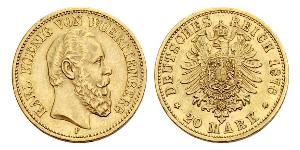
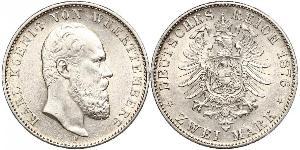
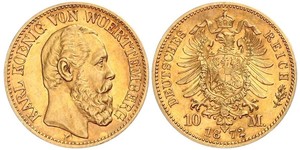
In numismatic terms, Charles appears as the sovereign authority on silver Thalers and copper coinages produced at the Stuttgart mint. His portrait was utilized extensively during his personal reign between 1864 and 1890. This imagery served a dual purpose: it affirmed local sovereignty within Württemberg while acknowledging its new status inside the German Empire.
- Mint Authority: Coins were minted for domestic use in Baden-Württemberg before national standardization was fully complete, utilizing state authority to validate currency legitimacy and reform.
- Lifetime Issue vs. Posthumous: The majority of circulated coinage displays his likeness as an active ruler; posthumal pieces are rare or exist only in commemorative contexts later released by the dynasty after 1891.
Why Collectors Value These Coins
Pieces depicting Charles offer historical enthusiasts a tangible connection to the late-nineteenth-century liberal movement. The artistic quality of these pieces reflects a shift away from baroque absolutism toward cleaner, more realistic portraits that mirrored contemporary political values.
Collectors are drawn to these issues because they encapsulate the evolution of authority in Europe at its apex before World War I. For those assembling regional European collections, coins bearing Charles' head provide essential markers for understanding how currency design responded to constitutional changes and shifting sovereignty dynamics within Germany between 1864 and 1870.