| Heinrich XIV, Prince Reuss Younger Line | Lien vers Wikipédia |
Heinrich XIV, Prince Reuss Younger Line (1832–1913): History and Coinage
In the complex political landscape of late 19th-century Germany stood Heinrich XIV, a pivotal figure in the House of Reuss. Born at Coburg on May 28, 1832, he inherited the throne of his principality upon the death of his father in July 1867.
Heinreich served as Prince from that date until March 29, 1913, a reign spanning crucial decades including German unification and World War I. Beyond ruling Reuss Younger Line, he also became regent for the Elder Line starting in 1902 due to his son’s physical disability at court life events.
This individual represents one of Germany's most significant minor sovereigns during the transition from empire to republic. His contributions extended beyond administration; notably in 1869 he founded the Reussian Prince Cross of Honour, an order that significantly impacted regional ceremonial culture and medal collecting practices for over a century.
Sovereign Representation on Currency
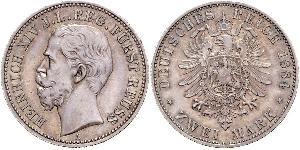
The depiction of Heinrich XIV on coins is tied to his role as head of state during a period when German local states retained full control over their monetary systems. Although he ruled alongside other princes within the larger Reich, Reuss Younger Line maintained its own minting prerogatives.
Coinage issued between 1867 and roughly 1905 often featured his portrait or monogram to signify local sovereignty and legitimacy under imperial law. Following unification in 1871, these states began adopting standardized metal compositions while retaining their own iconography until the revolution of 1918 abolished all monarchies.
The presence of his image on currency was a direct assertion of authority over subjects who relied upon that imagery to recognize valid tender. Collectors encounter pieces struck by mints in Reuss, where silver and copper coins circulated alongside Thalers before economic reforms standardized the wider German mark system at century's turn.
The Collector’s Perspective
Numerous collectors focus on this era because these artifacts capture the final breath of independent monarchical authority in Central Europe. Pieces from Reuss during Heinrich XIV’s reign are valued for their historical rarity and artistic craftsmanship typical of late-imperial mints.
- The scarcity of surviving specimens highlights how few coins were struck specifically before statehood dissolved entirely after 1918.
Educators emphasize these items as tools for understanding how regional politics shaped everyday life. By examining a coin struck in Reuss during his reign, one holds tangible evidence of continuity between the feudal past and modern republicanism that characterized Germany's path to democracy.